
UP Family ID 2026: Registration, Status, Update & Family Passbook
Summary
UP Family ID 2026 guide: learn How Family ID registration, eligibility, fees, status tracking, status , updates, Family Passbook and its use in Uttar Pradesh government scheme
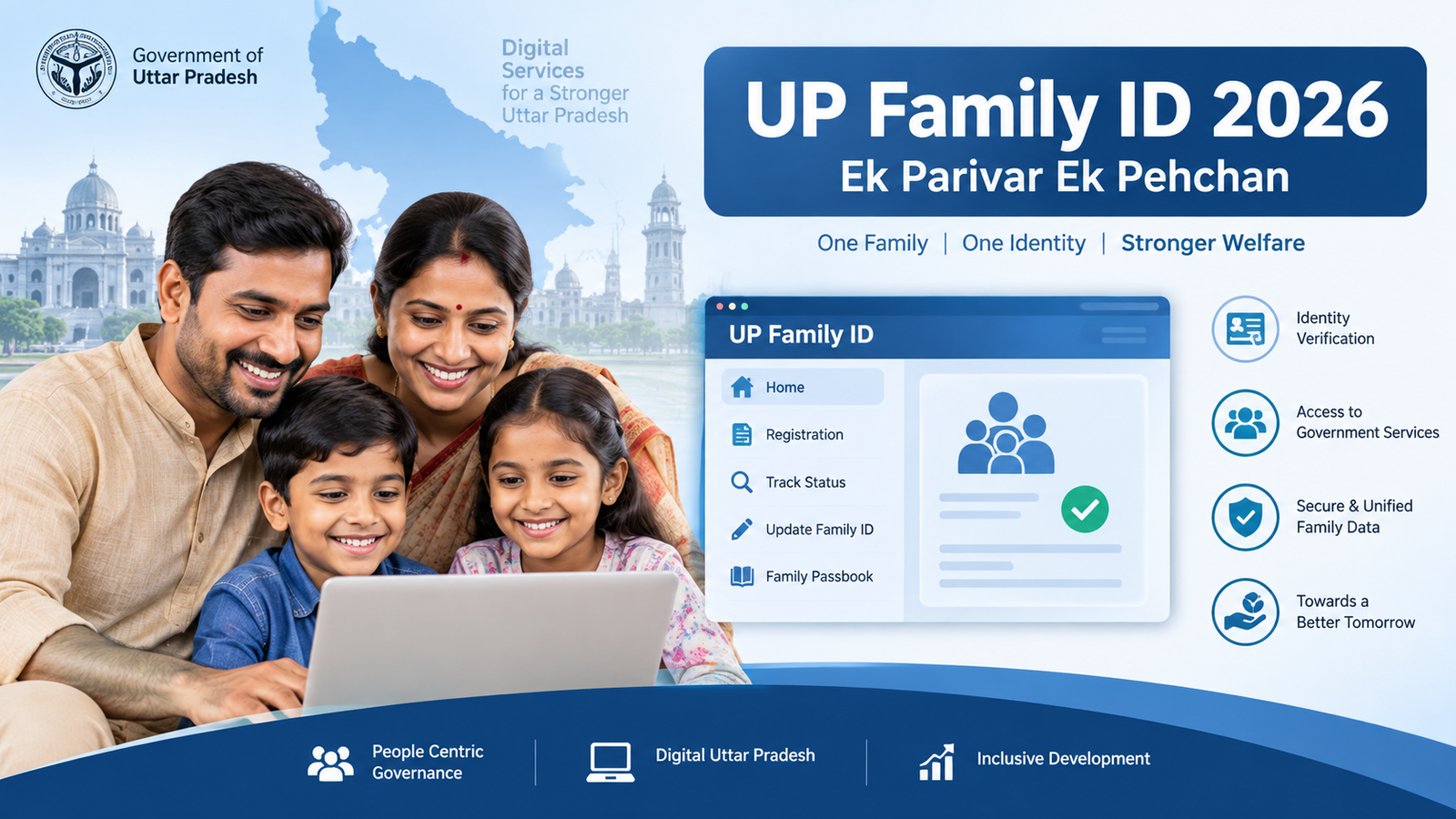
The UP Family ID 2026 system, also known as Ek Parivar Ek Pehchan, is an important digital-government initiative of the Uttar Pradesh Government. It is designed to create a unified family database so that eligible families can be identified more efficiently for government schemes, services, benefits and employment-related opportunities.
According to the Uttar Pradesh Planning Department, Family ID provides a unique identity to families. For families already covered by an Aadhaar-authenticated ration card, the ration card number serves as the Family ID. Families that do not have a ration card can register through the official Family ID portal and obtain a unique Family ID.
The Uttar Pradesh Budget 2026-27 also highlights the growing role of Family ID in government service delivery. The budget document reports that Family IDs had been created for approximately 4 crore families and 15.62 crore individuals, with 98 important schemes from 32 State and Central Government departments integrated with the Family ID database at the time of the budget document.
What Is UP Family ID?
UP Family ID is a family-level identification system created by the Government of Uttar Pradesh under the Ek Parivar Ek Pehchan initiative.
Unlike Aadhaar, which identifies an individual, Family ID is designed around the family unit. The system brings relevant family-member information together in a digital database that can be used by government departments for identifying beneficiaries and delivering eligible schemes and services.
The Planning Department explains that the main objective is to create a live and comprehensive database of family units and improve the identification of eligible beneficiaries.
- Creating a unified family database
- Improving beneficiary identification
- Supporting delivery of government schemes
- Reducing gaps in identification of eligible beneficiaries
- Helping departments integrate family-level information
Who Gets a UP Family ID?
There are two important situations that families should understand before starting a new registration.
Families With an Aadhaar-Authenticated Ration Card
According to the Uttar Pradesh Planning Department, for families covered by an Aadhaar-authenticated ration card, the ration card number serves as the Family ID.
Therefore, if your family already has an applicable ration card, you should first check the existing family record rather than creating another Family ID unnecessarily.
Families Without a Ration Card
Families that do not have a ration card can use the official Family ID portal to register themselves and their family members.
The Planning Department states that such families can obtain a unique 12-digit Family ID through the registration process.
This distinction is important because creating duplicate family records can cause inconsistencies in government databases.
Is UP Family ID Mandatory?
The Uttar Pradesh Planning Department's Family ID information describes enrolment as voluntary.
However, this should not be interpreted to mean that Family ID will never be relevant to any government service. As government departments integrate their schemes and services with the Family ID database, a particular scheme or service may use Family ID for family identification or verification.
Therefore, if a specific government scheme or service asks for Family ID, citizens should follow the requirement applicable to that service.
At the same time, having a Family ID does not automatically make a person eligible for every government scheme. Each scheme continues to have its own eligibility conditions.
What Is the Purpose of UP Family ID?
The Family ID system is intended to make government service delivery more efficient by creating a common family-level database.
Its important objectives include:
- Identifying eligible families and beneficiaries
- Improving delivery of welfare schemes
- Helping government departments use verified family information
- Reducing duplication in beneficiary identification
- Identifying families or individuals who may be eligible for government assistance
- Supporting integration of government schemes and services
The Uttar Pradesh Budget 2026-27 states that Family ID had already been integrated with 98 important schemes from 32 State and Central Government departments at the time of the budget document.
UP Family ID Registration: Who Should Apply?
Before creating a new Family ID, first determine whether your family already has one.
A new registration may be relevant when:
- Your family does not have a ration card.
- Your family is not already represented by an existing Family ID.
- You need to create a family record through the official Family ID system.
Avoid duplicate registration when:
- Your Aadhaar-authenticated ration card already serves as your Family ID.
- Your family already has an existing Family ID.
- Your family members are already included in an existing family record.
How to Register UP Family ID Online?
The official Family ID portal provides facilities for family registration and related services. The current portal interface also provides options such as Start Application, Track Status, Update Family ID and View Passbook.
The general registration process is as follows:
Step 1: Open the Official Family ID Portal
Open the official Uttar Pradesh Family ID portal. Use the government portal when entering Aadhaar, mobile number or family information.
Step 2: Start the Application
Select the registration or application option shown on the official portal and carefully read the instructions displayed on the screen.
Step 3: Complete Identity and Mobile Verification
Enter the information requested by the portal and complete the applicable Aadhaar and mobile-based verification process.
Step 4: Check Existing Family Information
The system can use Aadhaar-linked information to identify whether a family record already exists. Check the information carefully before proceeding with a new registration.
Step 5: Add Family Members
If a new Family ID is required, add the eligible family members according to the instructions provided by the portal.
Enter family-member information accurately. Do not add a person simply to complete the registration.
Step 6: Review Family Details
Before submitting the application, carefully check:
- Name spelling
- Date of birth, where displayed
- Aadhaar-related details
- Relationship between family members
- Mobile number
- Address
- Other information requested by the portal
Step 7: Submit the Application
Review the consent and declarations shown by the portal and submit the application after confirming that the information is correct.
Step 8: Save Application Details
After submission, save the application or reference information provided by the system. These details may be required when tracking the application later.
Is UP Family ID Registration Free?
The applicable government order provides different treatment depending on how the application is submitted.
For self-registration through the official portal, the Uttar Pradesh Government order states that no user charge is payable.
For applications submitted through a Jan Seva Kendra or Common Service Centre, the applicable government order specifies a ₹30 user charge for the Family ID service under the stated service-charge arrangement.
Because government service arrangements can be revised, citizens should check the current applicable information before paying any amount at a service centre.
How Is UP Family ID Verified?
Family ID registration involves verification. The Uttar Pradesh Government's guidelines describe a verification process through the applicable local administrative mechanism.
For rural areas, verification can involve the concerned Gram Panchayat-level officials according to the prescribed process. For urban areas, the applicable local administrative verification mechanism is followed.
This is why applicants should provide accurate information and avoid duplicate or incorrect family records.
How to Check UP Family ID Status?
The official Family ID portal provides a Track Status facility.
The general process is:
- Open the official Family ID portal.
- Select Track Status.
- Enter the application or reference information requested by the portal.
- Complete the required verification.
- View the current application status.
If an application is still under verification, do not create another application simply because processing has not completed. First check the status and follow the instructions provided by the official system.
How to Update UP Family ID?
Family circumstances can change over time. A family may need to update its information after events such as marriage, birth, death or other changes in the family record.
The current Family ID portal provides an Update Family ID facility.
Where an update is required, use the existing family record and follow the update process displayed on the official portal rather than creating another Family ID.
Depending on the type of change, the portal may require supporting information or verification.
What Is Family Passbook?
The Family ID portal also provides a View Passbook facility.
The Family Passbook is intended to provide a consolidated view of information associated with the family record in the Family ID system.
The exact information displayed can depend on the current portal implementation and the information available in the integrated databases. Therefore, citizens should rely on the information actually displayed in their official Family ID account.
Family ID and Government Schemes
One of the major purposes of Family ID is its integration with government schemes and services.
The Uttar Pradesh Budget 2026-27 reports that 98 important schemes from 32 State and Central Government departments had been integrated with the Family ID database at the time of the budget document.
However, Family ID does not automatically guarantee eligibility for any government scheme.
Each scheme can have separate conditions relating to:
- Age
- Income
- Category
- Residence
- Education
- Occupation
- Disability status
- Landholding
- Other scheme-specific requirements
Family ID can support identification and verification, but it does not replace the eligibility criteria of an individual government scheme.
Family ID and Aadhaar: What Is the Difference?
| Document/System | Main Purpose |
|---|---|
| Aadhaar | Individual identity |
| Family ID | Family-level identity and government database |
| Ration Card | Food-security beneficiary/family record |
| Income Certificate | Proof of specified income under applicable rules |
| Domicile Certificate | Proof of domicile/residence under applicable rules |
| Parivar Register Nakal | Copy of the applicable family register |
Aadhaar and Family ID therefore serve different purposes. Family ID should not be treated as a replacement for Aadhaar or other certificates.
Family ID vs Parivar Register Nakal
Family ID and Parivar Register Nakal are also different.
Family ID is a digital family identification system used for government-service and scheme integration.
Parivar Register Nakal is a copy or extract of the family register maintained through the applicable local administrative system.
If a government office specifically asks for a Parivar Register Nakal, do not automatically assume that a Family ID will be accepted as its replacement.
Similarly, if a particular government service specifically requires Family ID, a Parivar Register Nakal may not satisfy that requirement.
Common UP Family ID Problems
Family Already Has a Family ID
If your ration card already functions as the Family ID or your family already has a Family ID record, do not create a duplicate registration.
Aadhaar or Mobile Verification Problem
If the required OTP or Aadhaar verification cannot be completed, follow the authentication instructions displayed by the official portal instead of using an unofficial workaround.
Wrong Family Member Details
Do not enter incorrect information simply to complete registration. Use the official update or correction mechanism when available.
Application Pending
Use the official Track Status facility. A pending application should not automatically lead to another application.
Duplicate Family Record
Avoid registering the same family multiple times. Duplicate records can create problems when family information is used for government schemes and services.
UP Family ID 2026: Important Checklist
- Check whether your family already has an Aadhaar-authenticated ration card.
- Check whether the ration card number already serves as your Family ID.
- If your family has no ration card, check the official Family ID registration process.
- Keep the required Aadhaar and mobile verification information available.
- Enter every family member's details carefully.
- Check names and demographic information before submission.
- Read the consent and declarations displayed by the portal.
- Save your application/reference information.
- Track your application through the official portal.
- Use Update Family ID when an existing family record needs to be changed.
- Do not create duplicate family records.
- Remember that Family ID does not itself guarantee eligibility for a government benefit.
Final Word
The UP Family ID 2026 system is becoming an important part of Uttar Pradesh's digital government-service and welfare-delivery infrastructure.
For families with an Aadhaar-authenticated ration card, the ration card number serves as the Family ID. Families without a ration card can use the official Family ID portal to register themselves and their family members and obtain a unique Family ID.
The Uttar Pradesh Budget 2026-27 reports that approximately 4 crore families and 15.62 crore individuals were covered by Family ID, with 98 important schemes from 32 State and Central Government departments integrated with the database at the time of the budget document.
The most important practical advice is to avoid duplicate registration and keep family information accurate. If your family already has a valid Family ID, use the existing record and update it when necessary.
Finally, remember that Family ID is a family identification and database system. It does not automatically make a family eligible for every government scheme. The eligibility rules of the individual scheme always need to be checked separately.
Related Articles-Income Certificate /आय प्रमाण पत्र UP Online Apply 2026
Spotted something out of date? Tell us and we will re-check the source. Report a correction