
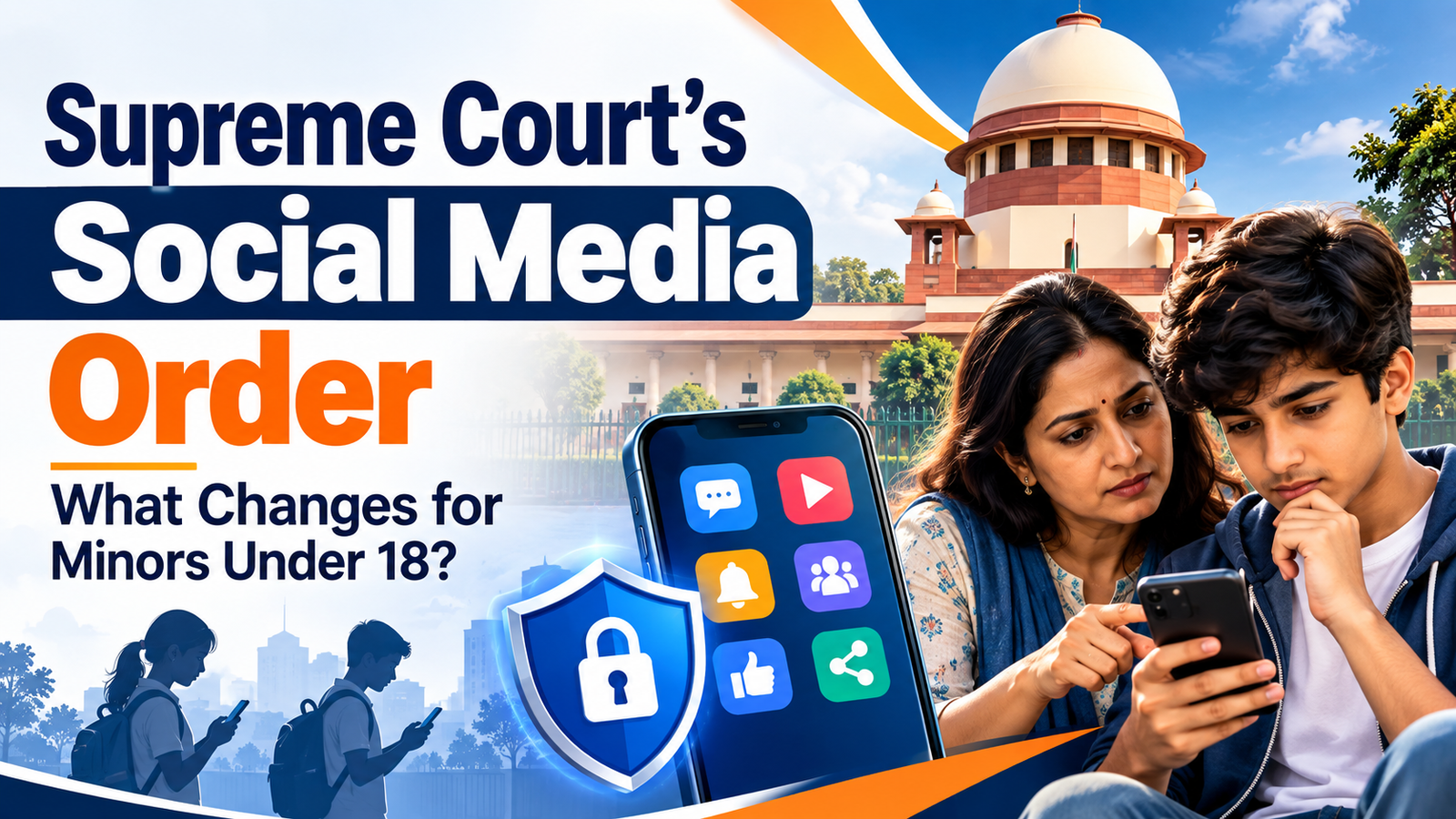
Supreme Court’s Social Media Order: What Will Change for Minors Under 18?
Summary
The Supreme Court has asked the Centre to examine statutory rules for minors’ social media accounts. Learn how parental consent, age verification and an 18+ rule may affect Instagram, YouTube, WhatsApp and other platforms.
Updated on: 29 September 2026
The Supreme Court of India has asked the Central Government to examine the possibility of introducing statutory safeguards for minors using social media and other digital platforms. The key issue is whether users below 18 should be allowed to create social media accounts independently, or whether parental consent and stronger age verification should become mandatory.
This does not mean that social media has been banned for people under 18. No immediate blanket ban has been imposed. However, the order signals that age verification, parental consent and platform responsibility may become stricter in the coming months.
What Happened?
A Supreme Court bench led by Chief Justice Surya Kant asked the Centre to examine whether statutory rules can be introduced under the Information Technology (Intermediary Guidelines and Digital Media Ethics Code) Rules, 2021 to protect minors online.
The Court raised an important legal question: under Indian law, a person below 18 cannot independently enter into a binding contract. The Court therefore questioned how social media platforms can allow minors to create accounts and accept platform terms without proper safeguards.
The case was heard after a petition by the NGO Just Rights for Children Alliance, which sought measures to prevent minors from creating and operating social media accounts without adequate protection.
What May Change for Users Below 18?
Final rules have not yet been notified, but the Supreme Court and the Centre are considering several possible safeguards:
- Minimum age of 18: Social media platforms may be required to enforce an 18-year minimum age for independently creating an account. [54][59]
- Parental consent: Minors may need consent from a parent or legal guardian before creating or continuing to use a social media account. [60][63]
- Stronger age verification: Platforms may have to use more reliable age-checking and identity verification systems. [63]
- Platform responsibility: Social media companies may need to ensure that their software and platform design comply with Indian laws relating to minors. [59]
- Data protection: The Digital Personal Data Protection Act, 2023 may also form part of the wider framework being considered.
Will Social Media Be Banned for Minors Now?
No. There is no immediate order banning all social media accounts for users below 18. The Supreme Court has asked the Centre to review the existing framework and consider a statutory mechanism for protecting minors online.
At present, platforms such as Instagram, YouTube, WhatsApp and Facebook continue to operate as usual. However, if new rules are introduced, minors may face stricter age verification, parental approval requirements and additional restrictions on data collection and targeted advertising.
What Should Parents Do Now?
Parents can also keep their child’s Aadhaar details updated, especially the mobile number and address, so that important government notifications and verification messages are not missed. Read our complete guide on Aadhaar update online.
Parents do not need to wait for final rules to improve their child’s online safety. They can take these practical steps today:
- Use Google Family Link to monitor apps, screen time and downloads on Android devices.
- Use Screen Time and Content & Privacy Restrictions on iPhones and iPads.
- Choose YouTube Kids or a supervised YouTube experience for younger children.
- Keep teen Instagram accounts private and review followers regularly.
- Teach children never to share OTPs, passwords, Aadhaar numbers, bank details or personal photographs.
- Encourage children to report unknown accounts, abusive messages, fake profiles and suspicious links.
Safe Social Media Checklist for Students
If you need help with identity, income or residence documents for school, scholarship or government services, check this CSC documents checklist before visiting a Common Service Centre.
- Do not share your real school name, home address or live location publicly.
- Do not accept follow requests from unknown accounts without checking their profile.
- Never share your account password, even with friends.
- Avoid clicking anonymous links, APK files, prize messages or “free recharge” offers.
- Use the platform’s report and block options for harassment or inappropriate content.
- Talk to a parent, teacher or trusted adult if something online makes you uncomfortable.
Why This Order Matters
Stronger online safeguards may also affect how families access digital health and welfare services. Learn how to check eligibility and apply for the Ayushman Bharat card.
This case is not limited to social media alone. It may also affect online gaming platforms, OTT apps, e-commerce platforms, AI chatbots and other digital intermediaries, as the Court is focusing on platform accountability and the safety of children online.
If the government introduces statutory rules, platforms may need to demonstrate how they identify underage users, obtain parental consent and protect children’s personal data.
Frequently Asked Questions
Has the Supreme Court banned social media?
No. The Court has asked the Centre to examine statutory safeguards for minors. There is no blanket ban on social media at present.
Can people below 18 still create Instagram accounts?
Yes, for now. Existing platform policies still apply, but future rules may require stronger age verification and parental consent.
When is the next hearing?
According to reports, the Supreme Court will hear the matter again after four weeks.
Will the rule apply only to Instagram?
No. The proposed safeguards may apply to all social media platforms and other digital intermediaries operating in India.
Conclusion
The Supreme Court’s order is an important step toward stronger online safety for children in India. While no immediate ban has been announced, the government is now examining whether parental consent, age verification and an 18-year minimum age threshold should be enforced for social media accounts. Parents should begin digital safety conversations and privacy settings now, rather than waiting for final rules.
Related Government Guides
- Aadhaar Update Online: Address, Mobile Number and Document Update Guide
- UP Birth Certificate Online Apply, Download and Correction Guide
- UP Income Certificate Online Apply: Documents, Fees and Download Guide
- UP Domicile Certificate Online Apply: Eligibility, Documents and Status
- Ayushman Bharat Card: Eligibility Check, Apply Online and Hospital List
- CSC Visit Documents Checklist: Aadhaar, PAN, Income and Address Proof
Spotted something out of date? Tell us and we will re-check the source. Report a correction